Manual 3-jaw self-centering scroll chuck for round workpieces and general lathe holding.
3-Jaw Self-Centering Chuck
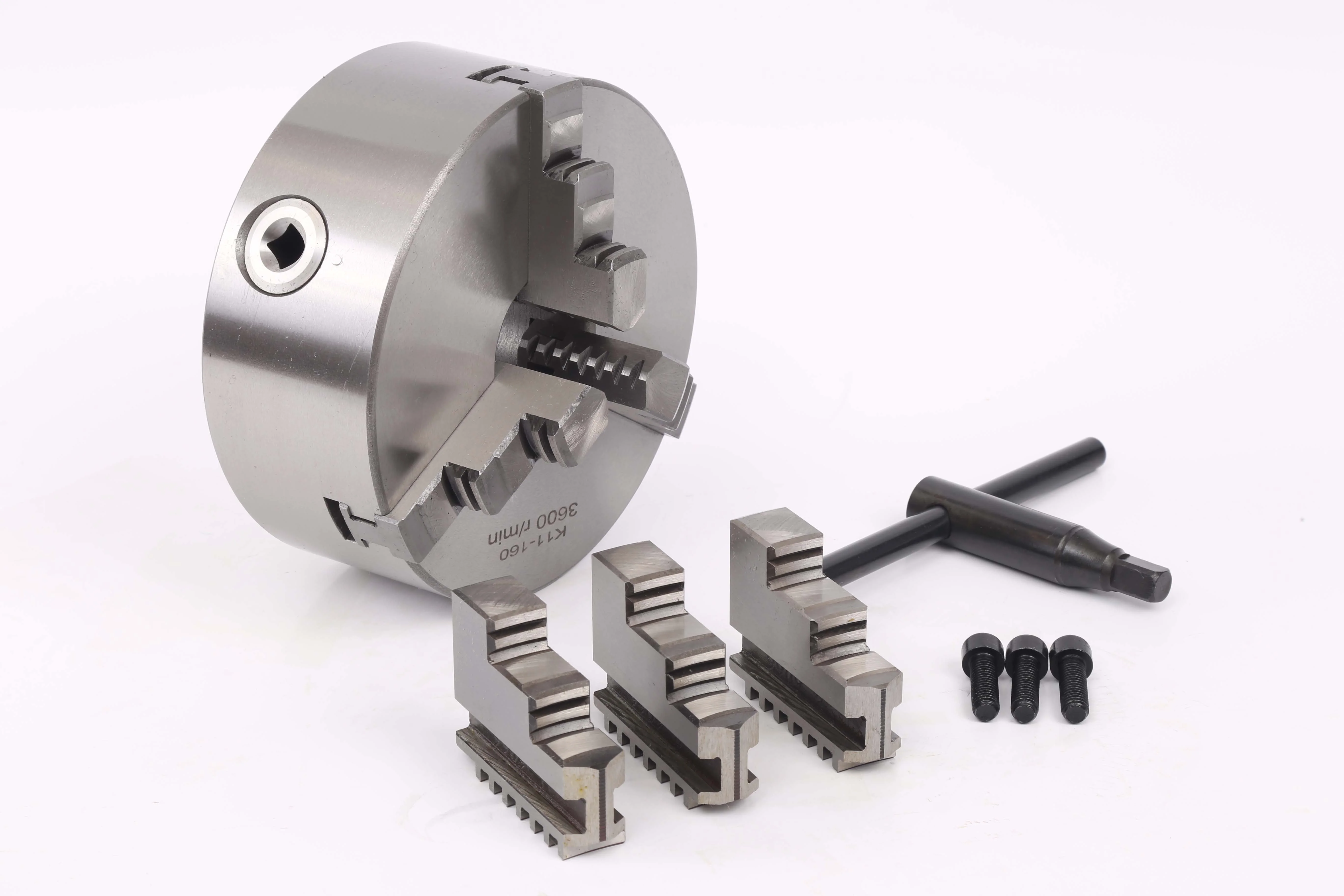
KORRETTO 3-Jaw Self-Centering Chuck is a manual lathe scroll chuck with synchronized jaw movement for round, hexagonal and regular workpieces. It is used for general turning and machining setups where quick centering and stable clamping are required.
Product Overview
The 3-jaw self-centering chuck is also known as a 3-jaw scroll chuck in many lathe applications because the internal scroll mechanism moves all three jaws together toward the center.
It is suitable for workpieces with regular outer profiles and is commonly used on manual lathes, conventional turning machines and general machining setups. Selection should confirm chuck size, mounting interface, clamping range, workpiece shape, required centering accuracy and machine compatibility.
Key Features
| Feature | Description |
|---|---|
| Self-centering scroll action | The internal scroll plate moves all three jaws together for quick centering of round and regular workpieces. |
| Manual lathe scroll chuck | A conventional manual scroll chuck for general turning and repeated setup work. |
| Efficient workpiece loading | Useful when round or hexagonal parts need repeated clamping. |
| Broad size range | Selected according to chuck diameter, clamping range and spindle interface. |
| Separate from independent chucks | Use independent chucks when each jaw must be adjusted separately. |
Typical Applications
- Round bar stock
- Hexagonal workpieces
- General turning operations
- Manual lathe workholding
- Repeated clamping of regular parts
- Standard machining setups
Technical Data and Dimensions
Use the drawing and parameter table to check chuck size, mounting dimensions, clamping range, spindle interface, net weight and machine compatibility.
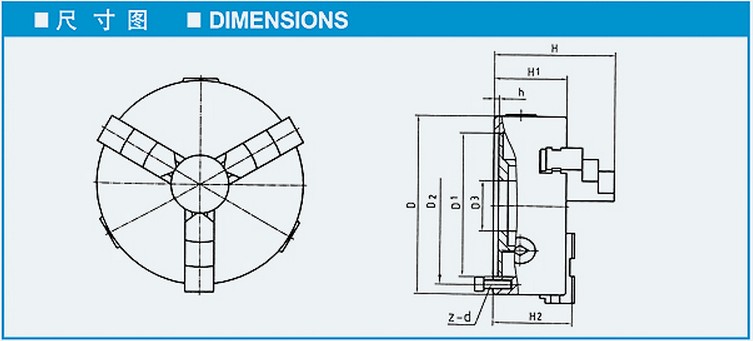
| Size D | D1 | D2 | D3 | H | H1 | H2 | h | z-d | Net Weight (kg) |
|---|---|---|---|---|---|---|---|---|---|
| 80 | 55 | 66 | 16 | 66 | 50 | — | 3.5 | 3-M6 | 1.7 |
| 100 | 72 | 84 | 22 | 74.5 | 55 | — | 3.5 | 3-M8 | 3.0 |
| 125 | 95 | 108 | 30 | 78 | 55 | — | 3.5 | 3-M8 | 4.5 |
| 130 | 100 | 115 | 30 | 86 | 60 | — | 3.5 | 3-M8 | 5 |
| 160 | 130 | 142 | 45 | 95 | 65 | — | 5 | 3-M8 | 8.2 |
| 160A | 130 | 142 | 45 | 109 | 65 | 71 | 5 | 3-M8 | 8.3 |
| 165 | 130 | 145 | 45 | 96.5 | 66.5 | — | 4.5 | 3-M8 | 9.3 |
| 190 | 155 | 172 | 55 | 105 | 75 | — | 5 | 3-M10 | 13.8 |
| 200 | 165 | 180 | 65 | 109 | 75 | — | 5 | 3-M10 | 15.1 |
| 200C | 165 | 180 | 65 | 122 | 75 | 78 | 5 | 3-M10 | 14.1 |
| 200A | 165 | 180 | 65 | 122 | 75 | 80 | 5 | 3-M10 | 14.1 |
| 240 | 195 | 215 | 70 | 120 | 80 | — | 8 | 3-M12 | 24 |
| 250 | 206 | 226 | 80 | 120 | 80 | — | 5 | 3-M12 | 25.8 |
| 250C | 206 | 226 | 80 | 130 | 80 | 84 | 5 | 3-M12 | 23.2 |
| 250A | 206 | 226 | 80 | 136 | 80 | 86 | 5 | 3-M12 | 23 |
| 315 | 260 | 285 | 100 | 147 | 90 | — | 7.5 | 3-M16 | 36 |
| 315C | 260 | 285 | 100 | 155 | 90 | 96 | 7.5 | 3-M16 | 36.1 |
| 320C | 265 | 290 | 100 | 155 | 90 | 96 | 7.5 | 3-M16 | 40.1 |
| 320A | 265 | 290 | 100 | 163.5 | 90 | 99.5 | 7.5 | 3-M16 | 40 |
| 325C | 272 | 296 | 105 | 155 | 90 | 96 | 7.5 | 3-M16 | 42 |
| 325A | 272 | 296 | 105 | 169.5 | 96 | 105.5 | 12 | 3-M16 | 46 |
| 380C | 325 | 350 | 135 | 163.5 | 98 | 103.5 | 7.5 | 3-M16 | 60 |
| 400C | 340 | 368 | 130 | 158.5 | 102 | 106.5 | 6 | 3-M16 | 65.8 |
| 500C | 440 | 465 | 200 | 197 | 115 | 121 | 6.5 | 6-M16 | 116.2 |
| 630C | 560 | 595 | 270 | 211.3 | 123 | 130.3 | 8 | 6-M16 | 208 |
| 800C | 710 | 760 | 385 | 247 | 149 | 157 | 8 | 6-M20 | 305 |
| 1000 | 910 | 950 | 400 | 278.6 | 176 | 185 | 8 | 6-M24 | 630 |
| 1250 | 1160 | 1200 | 660 | 280.6 | 178 | 187 | 10 | 6-M24 | 975 |
Related Manual Chuck Pages
FAQ
What is a 3-jaw self-centering chuck used for?
It is used for clamping round, hexagonal and regular workpieces where the jaws need to move together toward the center.
Is this the same as a 3-jaw independent chuck?
No. A self-centering chuck moves all jaws together. Independent jaws are adjusted separately.
When should I choose a 3-jaw self-centering chuck?
Choose it when the workpiece has a regular shape and quick centering is more important than individual jaw adjustment.
Can it hold square or irregular parts?
It is mainly intended for round or regular workpieces. Irregular parts usually require a 4-jaw independent chuck or a special fixture.
What should be checked before ordering?
Check chuck size, mounting interface, clamping range, workpiece shape, machine model and required accuracy.
Is this also called a scroll chuck?
Yes. In many lathe applications, a 3-jaw self-centering chuck is also called a scroll chuck because the internal scroll mechanism moves the jaws together toward the center.