KORRETTO · indexing plate solutions
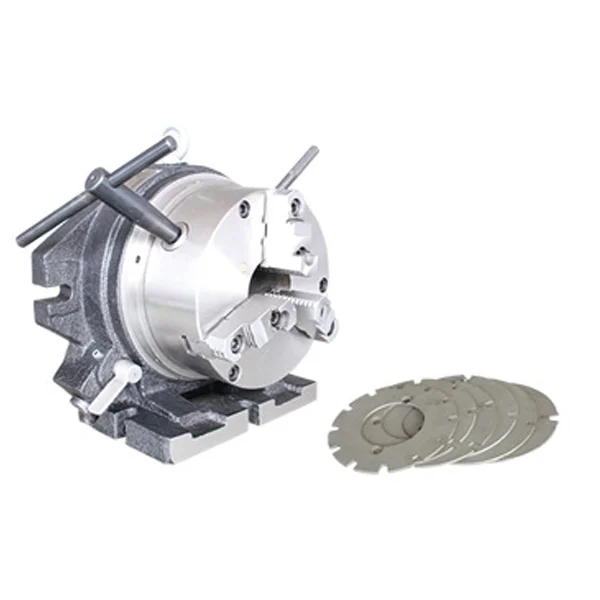
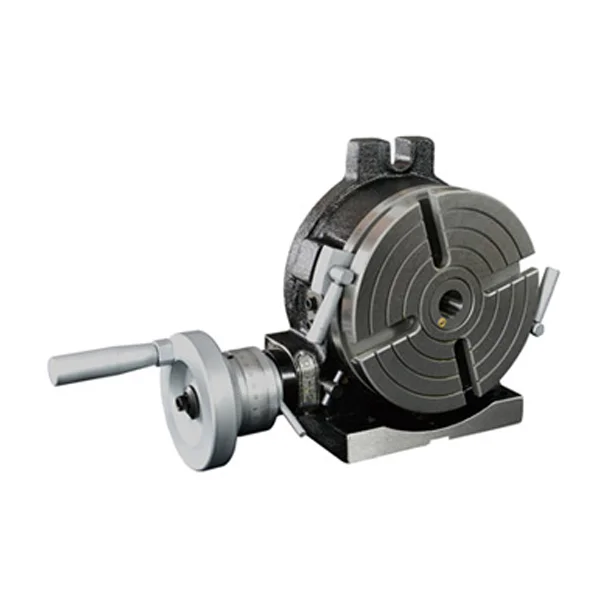
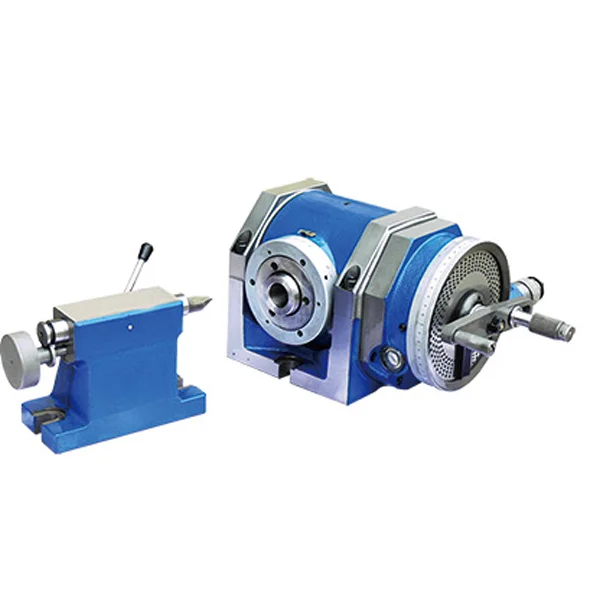
Horizontal and Vertical Super Indexing Plate
Horizontal and vertical super indexing plates are used for repeatable indexing and angular positioning. They are suitable for machining setups that need stronger support, flexible mounting direction and repeatable angular division.
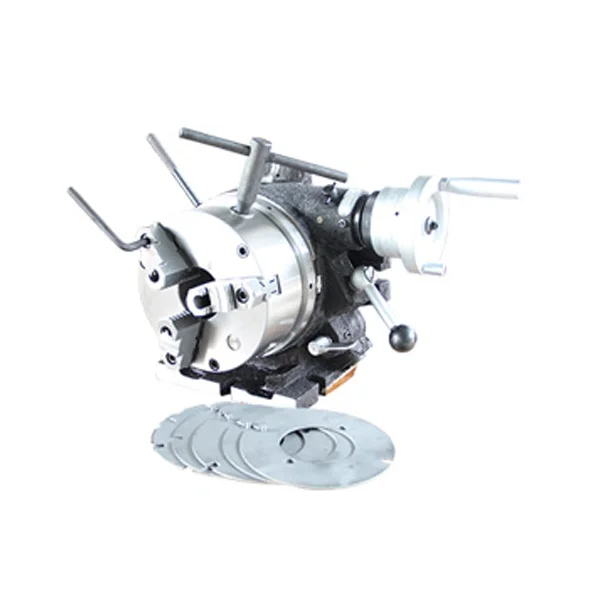
Product Overview
This series includes CS-6 and CS-8 super indexing plates. It supports horizontal and vertical mounting and is suitable for circular indexing, angular positioning and chuck-based machining setups requiring stronger indexing support.
Typical Applications
- Repeatable angular indexing and circular positioning operations.
- Horizontal or vertical setup configurations on milling and drilling machines.
- Machining tasks requiring stronger indexing support than simple indexing plates.
Key Features
Horizontal and vertical mounting flexibility.
Super indexing support for repeatable angular positioning.
Clear accuracy indicators for spacing error and runout control.
Chuck and faceplate size data for CS-6 and CS-8 selection.
Suitable for milling, drilling and circular indexing applications.
Parameters and Dimensions
Dimension drawings and tabulated data below can be used for selection and installation checks.
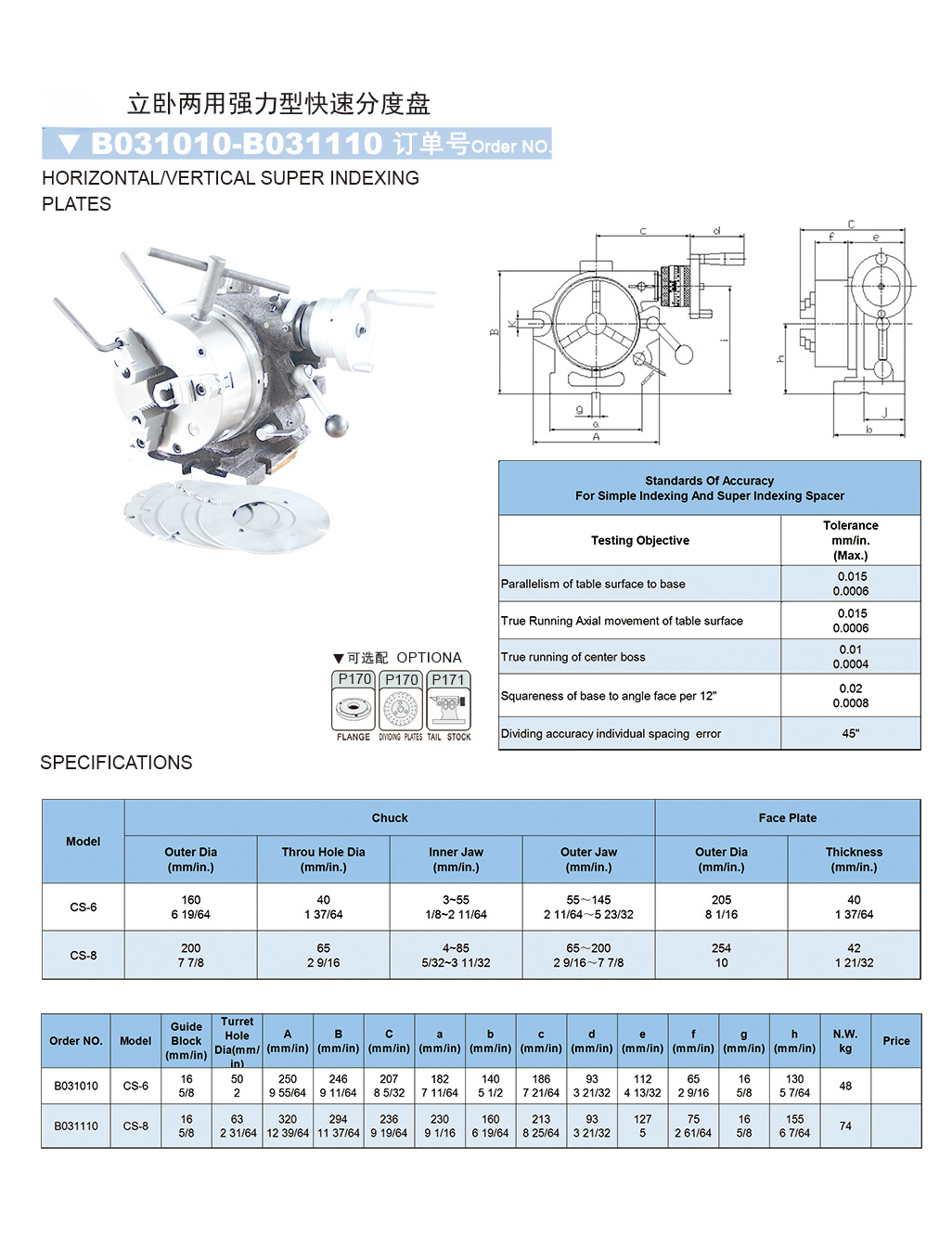
Accuracy Standard
| Inspection Item | Tolerance (max.) |
|---|---|
| Parallelism of table face to base | 0.015 mm / 0.0006 in. |
| Axial runout of table face | 0.015 mm / 0.0006 in. |
| Runout of center boss | 0.01 mm / 0.0004 in. |
| Perpendicularity of base to angular face (per 12") | 0.02 mm / 0.0008 in. |
| Indexing accuracy (individual spacing error) | 45" |
Chuck / Faceplate Specifications
| Model | Chuck Dia. | Through Hole Dia. | Inner Jaw Clamping | Outer Jaw Clamping | Faceplate Dia. | Faceplate Thickness |
|---|---|---|---|---|---|---|
| CS-6 | 160 / 6 19/64 | 40 / 1 37/64 | 3~55 / 1/8~2 11/64 | 55~145 / 2 11/64~5 23/32 | 205 / 8 1/16 | 40 / 1 37/64 |
| CS-8 | 200 / 7 7/8 | 65 / 2 9/16 | 4~85 / 5/32~3 11/32 | 65~200 / 2 9/16~7 7/8 | 254 / 10 | 42 / 1 21/32 |
Overall Dimensions and Net Weight
Dimensions are listed in mm / inch.
| Order No. | Model | Guide Block | Turret Bore | A | B | C | a | b | c | d | e | f | g | h | Net Weight (kg) |
|---|---|---|---|---|---|---|---|---|---|---|---|---|---|---|---|
| B031010 | CS-6 | 16 / 5/8 | 50 / 2 | 250 / 9 55/64 | 246 / 9 11/64 | 207 / 8 5/32 | 182 / 7 11/64 | 140 / 5 1/2 | 186 / 7 21/64 | 93 / 3 21/32 | 112 / 4 13/32 | 65 / 2 9/16 | 16 / 5/8 | 130 / 5 7/64 | 48 |
| B031110 | CS-8 | 16 / 5/8 | 63 / 2 31/64 | 320 / 12 39/64 | 294 / 11 37/64 | 236 / 9 19/64 | 230 / 9 1/16 | 160 / 6 19/64 | 213 / 8 25/64 | 93 / 3 21/32 | 127 / 5 | 75 / 2 61/64 | 16 / 5/8 | 155 / 6 7/64 | 74 |
Selection Notes
- Workpiece dimensions and required through-hole size.
- Required chuck holding range and model preference (CS-6 / CS-8).
- Machine interface and available installation space.
- Required indexing accuracy and repeatability level.
- Mounting direction and process details.
FAQ
What is a Horizontal and Vertical Super Indexing Plate used for?
It is used for repeatable indexing and angular positioning in milling or drilling setups, especially when stronger indexing support is required in horizontal or vertical mounting positions.
How is it different from a simple indexing plate?
A super indexing plate is selected when stronger support and more robust indexing are required. A simple indexing plate is usually selected for lighter or more basic division work.
How is it different from a chuck or indexing chuck?
This product is a table-side indexing accessory for milling and drilling setups. It is not a spindle-side chuck or an indexing chuck used for turning workholding.
What machine table or mounting interface should be confirmed?
Check the machine table size, T-slot layout, mounting space, chuck mounting condition and accessory interface before selection.
What workpiece size or load should be checked?
Confirm the workpiece diameter, weight, fixture height and chuck size so the selected indexing plate can support the setup safely.
What indexing or positioning requirement should be confirmed?
The required division positions, repeatability and machining process should be checked before the model is confirmed.
What should be checked before installation?
Check mounting direction, accessory compatibility, chuck installation, workpiece clearance and the handle operating space before installation.
What information is needed for quotation?
Please provide the machine model, chuck size, workpiece diameter, workpiece weight, required indexing positions and the current fixture layout.