KORRETTO · multi-angle rotary positioning solutions
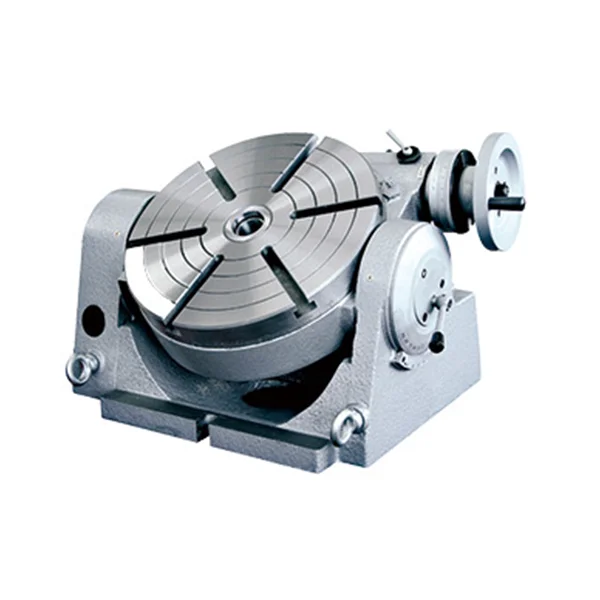
TRT Series Tilting Rotary Table
Tilting rotary tables are used when the workpiece needs both rotary positioning and angular tilt adjustment. They are suitable for milling, drilling and positioning setups where the table angle must be adjusted from the horizontal plane.
Product Overview
This series includes TRT160, TRT200, TRT250, RTR320 and TRT400. It combines rotary indexing with tilt adjustment to support inclined-face machining and multi-angle positioning on machine tables.
Typical Applications
- Inclined-face milling and drilling where rotary positioning and tilt are both required.
- Multi-angle positioning tasks requiring 0° to 90° table tilt adjustment.
- Setup transitions between standard rotary indexing and angled machining surfaces.
- Machine-table projects requiring stable tilt + rotary positioning support.
Key Features
0°–90° tilt-angle adjustment for inclined machining setups.
Rotary indexing table function combined with angular tilt positioning.
Clear model coverage from TRT160 to TRT400 including RTR320.
Dimension and load data for installation and process planning.
Suitable for milling, drilling and multi-angle positioning operations.
Parameters and Dimensions
Dimension drawings and tabulated data below can be used for selection and installation checks.
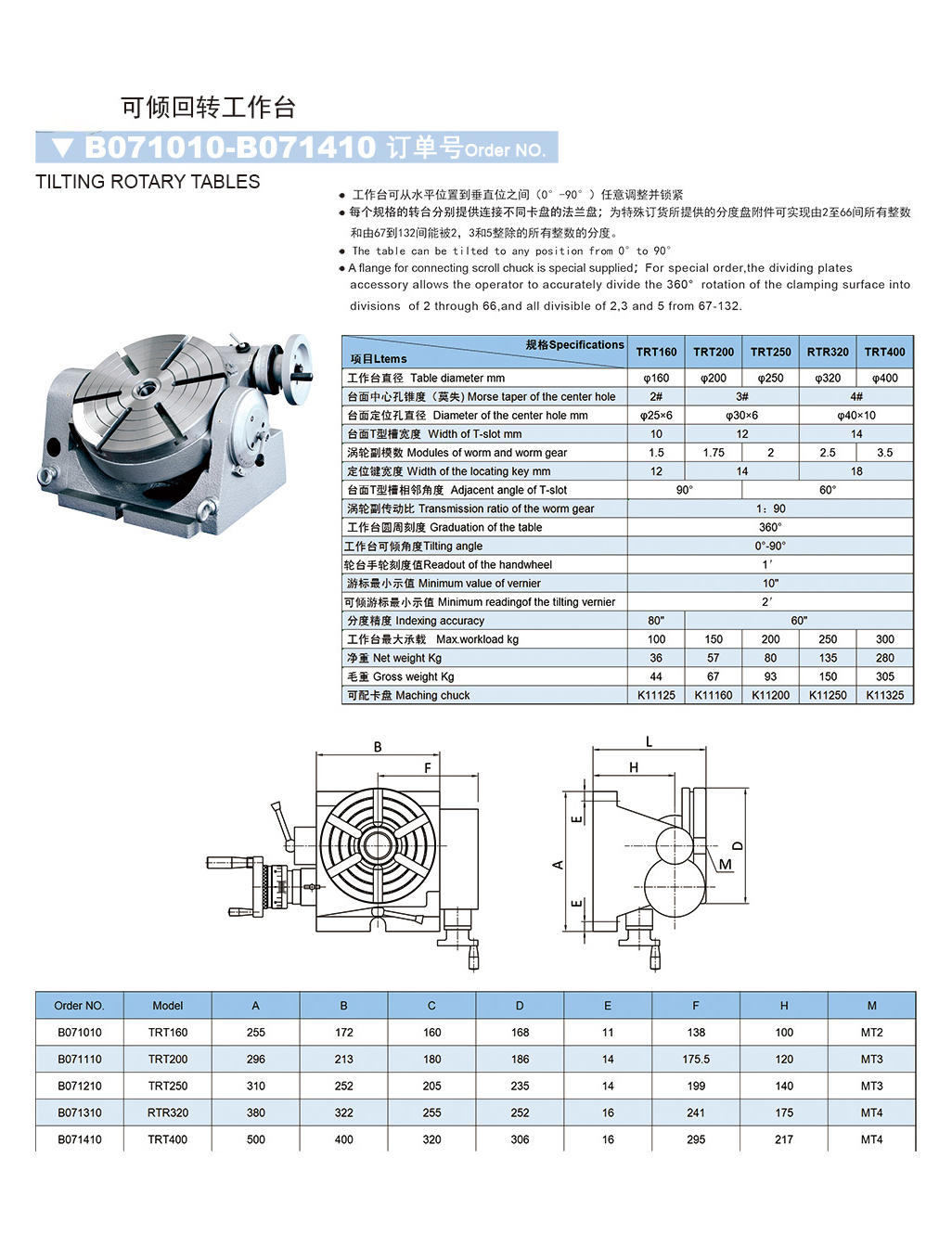
Specification Table
| Item | TRT160 | TRT200 | TRT250 | RTR320 | TRT400 |
|---|---|---|---|---|---|
| Table Diameter (mm) | φ160 | φ200 | φ250 | φ320 | φ400 |
| Center Taper (Morse) | 2# | 3# | 3# | 4# | 4# |
| Center Bore Diameter | φ25×6 | φ30×6 | φ30×6 | φ40×10 | φ40×10 |
| T-slot Width (mm) | 10 | 12 | 12 | 14 | 14 |
| Worm Module | 1.5 | 1.75 | 2 | 2.5 | 3.5 |
| Locating Key Width (mm) | 12 | 14 | 14 | 18 | 18 |
| Adjacent T-slot Angle | 90° | 90° | 90° | 60° | 60° |
| Worm Ratio | 1:90 | 1:90 | 1:90 | 1:90 | 1:90 |
| Table Circumferential Scale | 360° | 360° | 360° | 360° | 360° |
| Tilt Range | 0°–90° | 0°–90° | 0°–90° | 0°–90° | 0°–90° |
| Handwheel Graduation | 1′ | 1′ | 1′ | 1′ | 1′ |
| Vernier Minimum Reading | 10" | 10" | 10" | 10" | 10" |
| Tilting Vernier Minimum Reading | 2′ | 2′ | 2′ | 2′ | 2′ |
| Indexing Accuracy | 80" | 80" | 80" | 60" | 60" |
| Max Table Load (kg) | 100 | 150 | 200 | 250 | 300 |
| Net Weight (kg) | 36 | 57 | 80 | 135 | 280 |
| Gross Weight (kg) | 44 | 67 | 93 | 150 | 305 |
| Compatible Chuck | K11125 | K11160 | K11200 | K11250 | K11325 |
Order Dimension Table
Dimensions are in mm.
| Order No. | Model | A | B | C | D | E | F | H | M |
|---|---|---|---|---|---|---|---|---|---|
| B071010 | TRT160 | 255 | 172 | 160 | 168 | 11 | 138 | 100 | MT2 |
| B071110 | TRT200 | 296 | 213 | 180 | 186 | 14 | 175.5 | 120 | MT3 |
| B071210 | TRT250 | 310 | 252 | 205 | 235 | 14 | 199 | 140 | MT3 |
| B071310 | RTR320 | 380 | 322 | 255 | 252 | 16 | 241 | 175 | MT4 |
| B071410 | TRT400 | 500 | 400 | 320 | 306 | 16 | 295 | 217 | MT4 |
Selection Notes
- Machine model and available table installation space.
- Required tilt angle range and indexing operation requirements.
- Workpiece size, load and fixture constraints.
- Center taper, T-slot and compatible chuck requirements.
- Process details for milling, drilling and positioning operations.
FAQ
What is the TRT Series Tilting Rotary Table used for?
It is used when the machining process needs both rotary positioning and angular tilt adjustment, such as inclined-face milling and angled drilling setups.
How is it different from a standard rotary table?
A tilting rotary table adds angular tilt adjustment in addition to rotary positioning. A standard horizontal rotary table is selected when tilt adjustment is not required.
How should the tilt angle range be selected?
The required machining angle, tool approach direction and fixture height should be checked against the tilt range before the model is selected.
What machine table or mounting interface should be confirmed?
Check the machine table size, T-slot layout, mounting bolts, tilt-side clearance and the available installation space.
What workpiece size or load should be checked?
Confirm the workpiece diameter, weight, fixture height, eccentric load and overhang so the selected table can support the inclined setup safely.
What positioning or indexing accuracy should be confirmed?
The required angular positioning, repeatability and tilt-angle accuracy should be checked against the machining tolerance.
What should be checked before installation?
Check tilt-side interference, lubrication condition, handle travel, locking condition and the machine travel envelope before installation.
What information is needed for quotation?
Please provide the machine model, required table diameter, workpiece dimensions, workpiece weight, tilt angle requirement and machining process.