KORRETTO · CLAMPING HEAD SYSTEMS
Clamping Head Chuck with Inner Stop
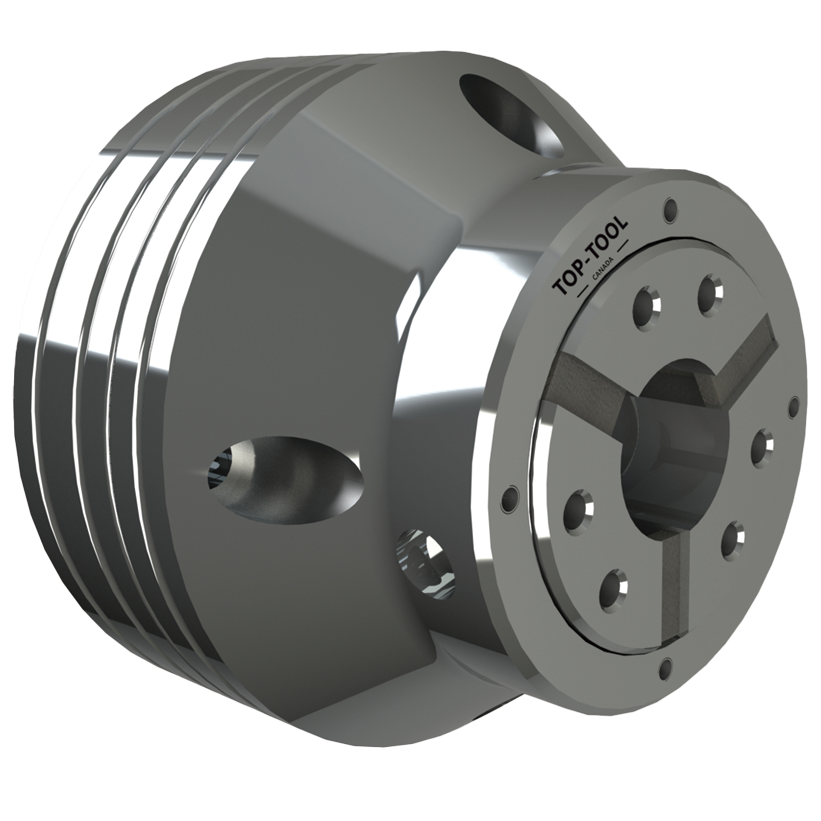
The Clamping Head Chuck with Inner Stop combines outside-diameter gripping with an inner workpiece stop. The rubber-flex head supports the gripping surface while the stop establishes axial location for repeated loading of shafts, sleeves and short parts.
How It Works
The clamping head closes around the workpiece outside diameter as the part seats against the stop. The stop is a locating component, not an internal expanding element. Match its position and contact face to the part length and machining access.
Selection should confirm the workpiece diameter, clamping length, stop position, locating face, collet type, draw force, clamping force, maximum speed and machine layout.
Key Features
Axial workpiece location
A defined stop helps maintain repeat loading position.
Outside-diameter gripping
Steel segments distribute contact around the workpiece.
Short and long shafts
Choose the stop and head arrangement for the actual workpiece.
Replaceable clamping head
Change compatible heads for different part sizes.
Typical Applications
- Shafts and sleeves requiring repeat length control
- Short parts with axial locating requirements
- Outside clamping with internal stop
- Precision turning and finishing
- Repeated loading in CNC production
Technical Data: Clamping Head Chuck with Inner Stop
Use the drawing and parameter tables to check chuck structure, inner stop arrangement, clamping range, stroke, draw force, radial clamping force, maximum speed and workpiece compatibility.
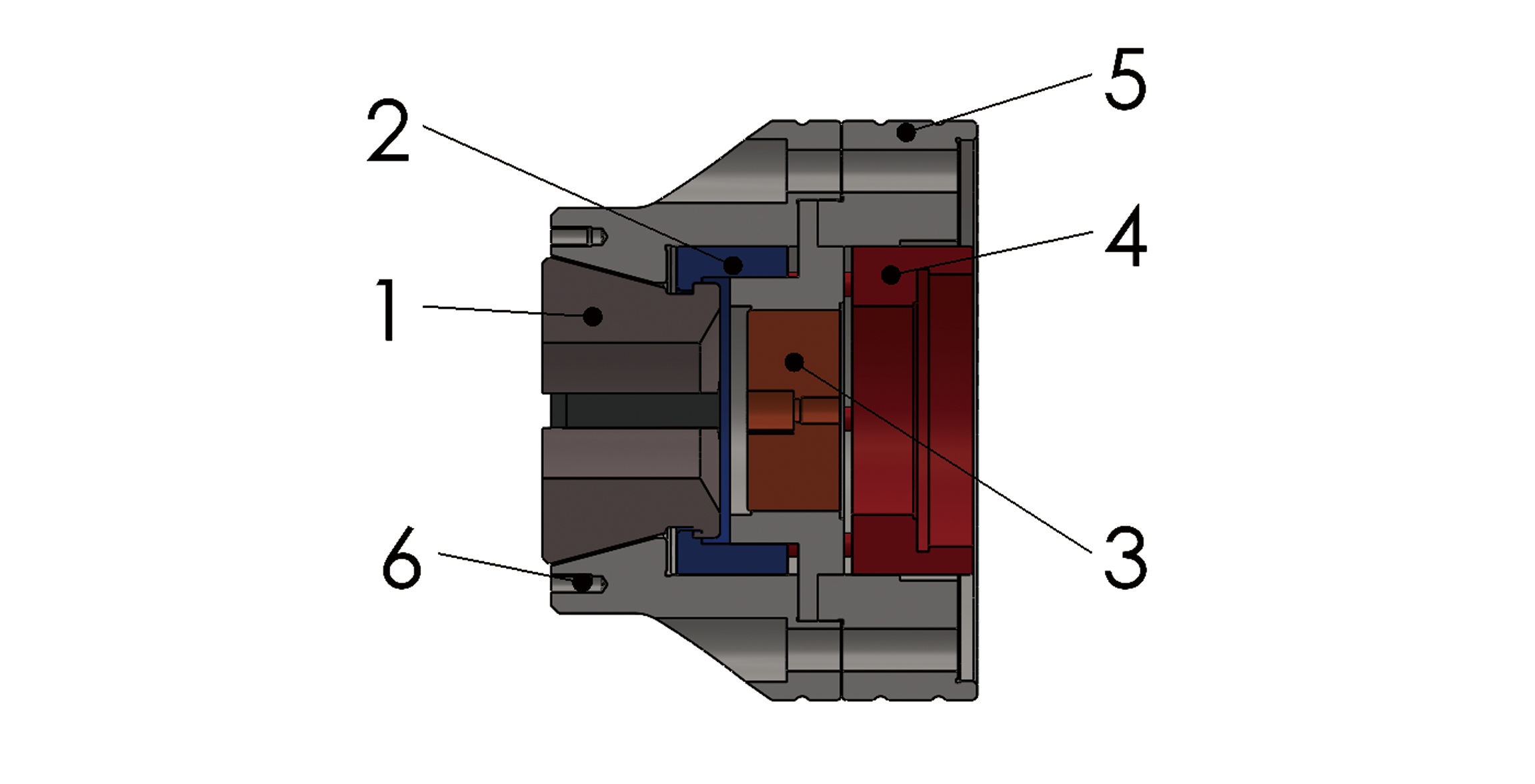
| No. | Structure Name |
|---|---|
| 1 | Segmented Steel Clamping Head |
| 2 | Clamping Head Push-Pull Ring |
| 3 | Face Stop |
| 4 | Draw Bar Connection Thread |
| 5 | Spindle Flange |
| 6 | Front Stop Mounting Thread |
| Specification | Stroke (mm) | Maximum Draw Force (kN) | Maximum Radial Clamping Force (kN) | Maximum Clamping Diameter (mm) | Recommended Workpiece Tolerance (mm) | Maximum Speed (r/min) |
|---|---|---|---|---|---|---|
| 32 | 2.5+3 | 25 | 70 | 32 | ±0.3 | 8000 |
| 42 | 2+2.5 | 35 | 80 | 42 | ±0.5 | 7000 |
| 52 | 2+2.5 | 40 | 94 | 52 | ±0.5 | 7000 |
| 65 | 2+2.5 | 45 | 105 | 65 | ±0.5 | 6000 |
| 80 | 2+2.5 | 50 | 115 | 80 | ±0.5 | 5500 |
| 100 | 3+5 | 65 | 150 | 100 | ±1.0 | 5000 |
| 125 | 3+6 | 70 | 165 | 125 | ±1.0 | 3200 |
| 160 | 3+3 | 100 | 235 | 160 | ±1.0 | 3200 |
What to Provide Before Quotation
- Part diameter, gripping length and locating face
- Stop position and required finished length
- Spindle connection, force, speed and head code
Related Clamping Head Systems
FAQ
What is the Clamping Head Chuck with Inner Stop used for?
It grips the workpiece outside diameter while an inner stop establishes axial location during repeat loading.
Is this an internal expansion mandrel?
No. This product clamps the workpiece from the outside. The inner stop is used for locating, not for internal expansion clamping.
When should I choose an inner stop?
Choose an inner stop when the workpiece must seat against a locating reference during repeated loading.
Is this the same as a Segmented Clamping Head?
No. The clamping head is the replaceable gripping element. This product includes the chuck body and an inner workpiece stop.
Is it suitable for thin-wall or easily marked parts?
It can be suitable because steel-segment contact helps distribute clamping force more evenly. Final suitability still depends on wall thickness, clamping length, cutting load and trial clamping.
What information should I provide?
Provide the workpiece drawing, clamping diameter, clamping length, locating face, stop position, tolerance, machine layout and accuracy requirement.
What segmented clamping head data can be referenced during selection?
The matching segmented clamping head series may be referenced for collet accuracy up to 0.01 mm, chuck body accuracy up to 0.005 mm and collet hardness HRC 58 to 62. These values describe the matching collet series and should be checked together with the selected chuck model and clamping range.
Can the stop position be matched to my workpiece?
The stop arrangement should be checked from the workpiece drawing and the chuck structure before selection.