Hollow and solid rotary hydraulic cylinders for CNC lathe chuck actuation and drawbar movement.
Rotary Hydraulic Cylinder
KORRETTO rotary hydraulic cylinders drive hydraulic chuck clamping and release through the chuck drawbar on CNC lathes. This page covers both hollow rotary hydraulic cylinders and solid rotary hydraulic cylinders. Hollow or through-hole cylinders are used when bar stock or tube stock must pass through the spindle, while solid or closed-center cylinders are used when through-spindle feeding is not required.
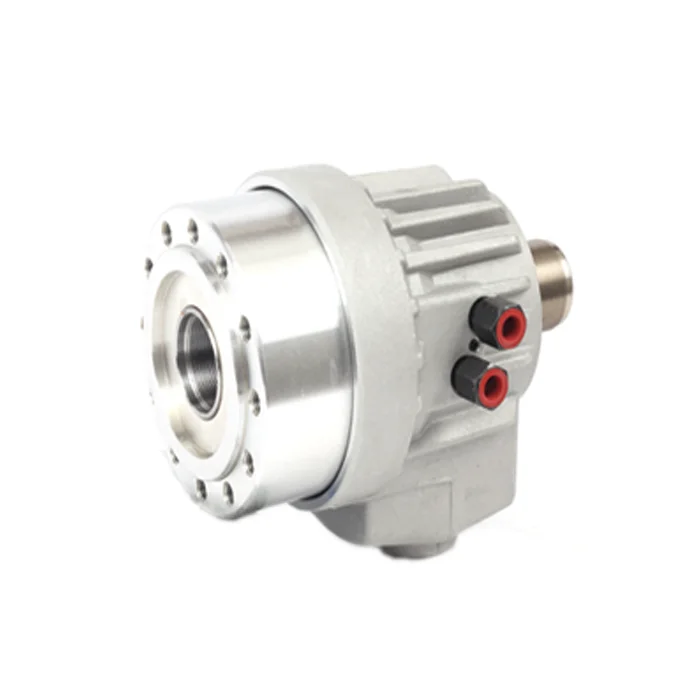
Product Overview
A rotary hydraulic cylinder is the hydraulic chuck actuator that provides the push force, pull force and stroke needed to clamp and release a CNC lathe hydraulic chuck. It must be selected together with the chuck, drawbar, spindle nose and hydraulic system.
This page is a combined page for hollow and solid rotary hydraulic cylinders. The two types must be displayed in separate sections so users can clearly see which drawing and parameter table belong to which cylinder type.
How the Rotary Hydraulic Cylinder Drives the Chuck
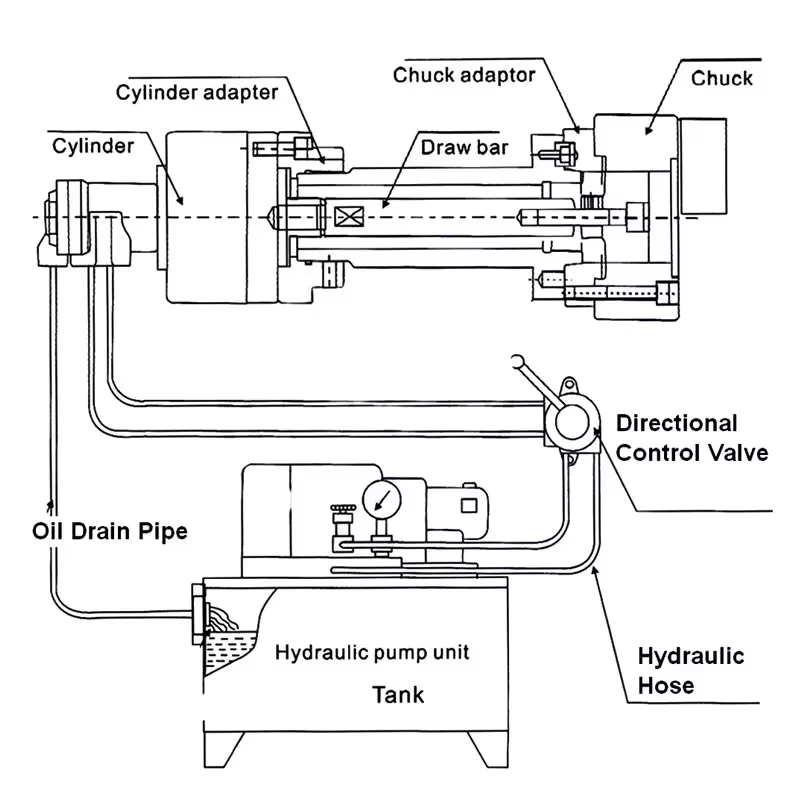
The rotary hydraulic cylinder supplies axial push or pull to the chuck through a drawbar or drawtube. Its piston stroke must match the chuck input stroke, and the available force depends on hydraulic pressure and the effective piston area on the working side.
- Pressure is not gripping force: Cylinder pressure, axial drawbar force and jaw gripping force are different quantities. Match the cylinder output to the chuck input limit.
- Push side and pull side: The effective areas can differ on the two sides of the piston. Use the force corresponding to the direction that operates the chuck, rather than choosing by piston diameter alone.
- Cylinder operating speed: Check the cylinder speed rating as well as the chuck and workpiece setup. Select a cylinder that meets the intended spindle speed and hydraulic operating conditions.
Hollow and Solid Rotary Hydraulic Cylinder Types
| Type | Description | Typical use |
|---|---|---|
| Hollow Rotary Hydraulic Cylinder | Rotary cylinder with through-hole structure. | Bar stock, tube stock and machines requiring through-spindle material passage. |
| Solid Rotary Hydraulic Cylinder | Rotary cylinder without through-hole passage. | Short workpieces, individual blanks and solid chuck systems. |
Technical Data and Dimensions
The hollow and solid rotary hydraulic cylinders are shown in separate groups so the drawings and parameter tables can be matched to the correct structure.
Hollow Rotary Hydraulic Cylinder
Hollow rotary hydraulic cylinder for through-spindle bar or tube work.
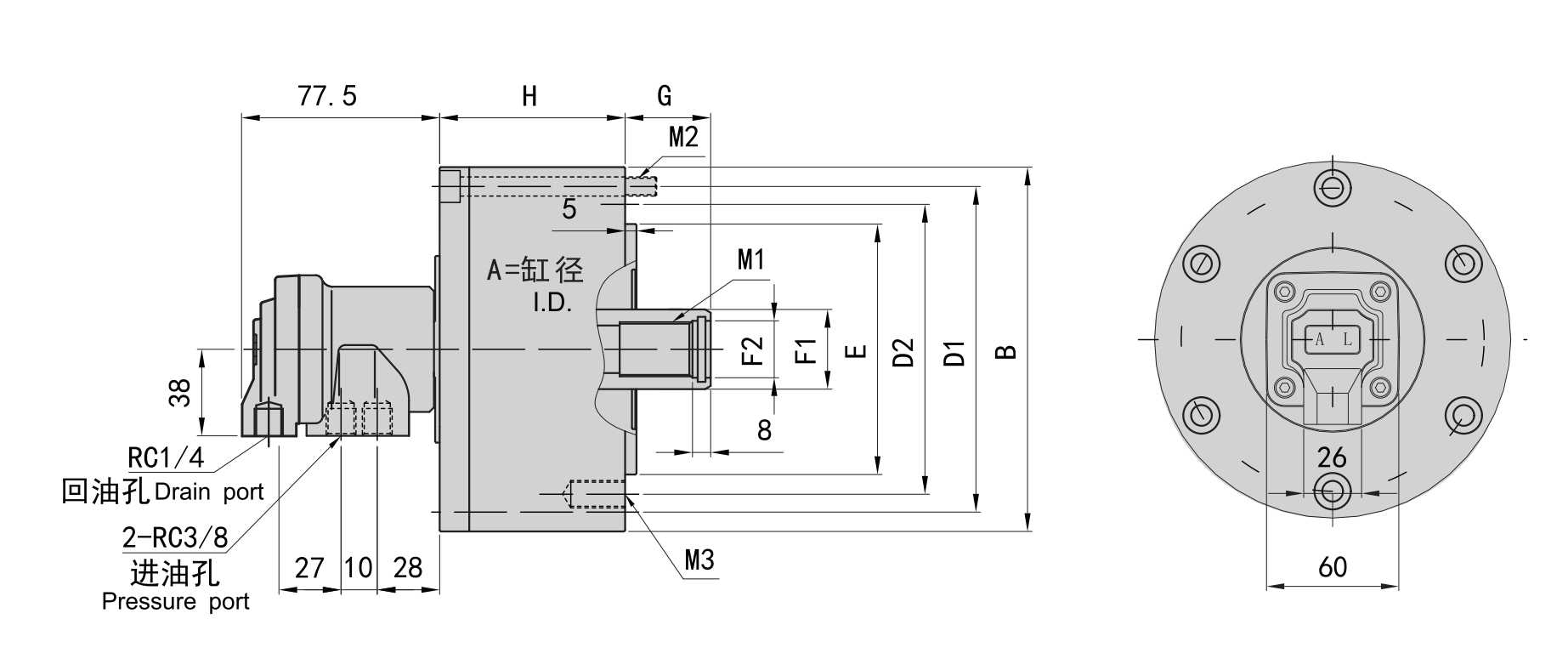
Use this drawing to confirm the hollow cylinder dimensions and drawbar connection.
| Model | A (Piston Diameter) | B | D1 | D2 | E(H7) | F1 | F2(H8) | G1 max | G1 min | G2 max | G2 min | H | J | K | L1 | L2 | M1 | M2 |
|---|---|---|---|---|---|---|---|---|---|---|---|---|---|---|---|---|---|---|
| KY-428T | 90 | 124 | 100 | 108 | 80 | 40 | 30 | 10 | 0 | 35 | 25 | 61 | 94.5 | 139 | 25 | 13 | M33*1.5 | 6-M8*65 |
| KY-532T | 105 | 141 | 115 | 125 | 100 | 48 | 35 | 15 | 0 | 40 | 25 | 70 | 107.5 | 148 | 25 | 13 | M38*1.5 | 6-M8*65 |
| KY-536T | 105 | 141 | 115 | 125 | 100 | 48 | 38 | 15 | 0 | 40 | 25 | 70 | 107.5 | 148 | 25 | 13 | M42*1.5 | 6-M8*75 |
| KY-642T | 125 | 156 | 130 | 140 | 100 | 65 | 45 | 15 | 0 | 40 | 25 | 70 | 107.5 | 148 | 25 | 13 | M50*2 | 6-M8*75 |
| KY-646T | 125 | 156 | 130 | 140 | 100 | 65 | 50 | 15 | 0 | 40 | 25 | 70 | 107.5 | 148 | 25 | 13 | M55*2 | 6-M8*75 |
| KY-846T | 145 | 185 | 170 | 165 | 130 | 70 | 50 | 20 | 0 | 45 | 25 | 72 | 107.5 | 150 | 30 | 12 | M55*2 | 6-M8*75 |
| KY-852T | 145 | 185 | 170 | 165 | 130 | 70 | 55 | 20 | 0 | 45 | 25 | 72 | 107.5 | 150 | 30 | 12 | M60*2 | 6-M8*75 |
| KY-1068T | 175 | 215 | 190 | 190 | 160 | 95 | 70 | 25 | 0 | 50 | 25 | 94 | 136 | 188 | 35 | 16 | M75*2 | 6-M10*100 |
| KY-1075T | 175 | 215 | 190 | 190 | 160 | 95 | 80 | 25 | 0 | 50 | 25 | 94 | 136 | 188 | 35 | 16 | M85*2 | 6-M10*100 |
| KY-1287T | 205 | 240 | 215 | 220 | 180 | 110 | 90 | 30 | 0 | 55 | 25 | 100 | 145 | 205 | 35 | 16 | M95*2 | 6-M10*105 |
| KY-1291T | 205 | 240 | 215 | 220 | 180 | 110 | 95 | 30 | 0 | 55 | 25 | 100 | 145 | 205 | 35 | 16 | M100*2 | 6-M10*105 |
| KY-1511T | 250 | 305 | 275 | 280 | 230 | 140 | 115 | 30 | 0 | 55 | 25 | 113 | 156 | 245 | 35 | 16 | M120*2 | 6-M12*120 |
| KY-1512T | 250 | 305 | 275 | 280 | 230 | 140 | 125 | 30 | 0 | 55 | 25 | 113 | 156 | 245 | 35 | 16 | M130*2 | 6-M12*120 |
| Model | M3 | M4 | M5 | O | P | Q1 | Q2 | R | S | T | U | V | W1 | W2 | X | Y |
|---|---|---|---|---|---|---|---|---|---|---|---|---|---|---|---|---|
| KY-428T | 6-M8*16 | M34*1.5 | 4-M5 | 28 | 99 | 9 | 24 | 32 | 52 | 60 | 88 | 6 | 56.5 | 100 | 44 | 76 |
| KY-532T | 6-M10*16 | M44*1.5 | 4-M5*6 | 32 | 108 | 9 | 30 | 42 | 62 | 70 | 98 | 6 | 62 | 110 | 54 | 83 |
| KY-536T | 6-M10*16 | M44*1.5 | 4-M5*6 | 36 | 108 | 9 | 30 | 42 | 62 | 70 | 98 | 6 | 62 | 110 | 54 | 83 |
| KY-642T | 12-M10*20 | M52*1.5 | 4-M5*6 | 42 | 108 | 9 | 32 | 50 | 76 | 85 | 116 | 6 | 70 | 120 | 64 | 98 |
| KY-646T | 12-M10*20 | M52*1.5 | 4-M5*6 | 46 | 108 | 9 | 32 | 50 | 76 | 85 | 116 | 6 | 70 | 120 | 64 | 98 |
| KY-846T | 12-M10*20 | M58*1.5 | 4-M6*6 | 46 | 110 | 9 | 36 | 56 | 85 | 96 | 128 | 7 | 79 | 130 | 73 | 110 |
| KY-852T | 12-M10*20 | M58*1.5 | 4-M6*6 | 52 | 110 | 9 | 36 | 56 | 85 | 96 | 128 | 7 | 79 | 130 | 73 | 110 |
| KY-1068T | 12-M10*20 | M84*2 | 4-M6*8 | 68 | 139 | 12 | 36 | 81 | 108 | 121 | 164 | 7 | 98 | 160 | 98 | 155 |
| KY-1075T | 12-M10*20 | M84*2 | 4-M6*8 | 75 | 139 | 12 | 36 | 81 | 108 | 121 | 164 | 7 | 98 | 160 | 98 | 155 |
| KY-1287T | 12-M12*24 | M99*2 | 4-M6*8 | 87 | 148 | 14 | 40 | 96 | 125 | 135 | 180 | 7 | 110 | 185 | 110 | 165 |
| KY-1291T | 12-M12*24 | M99*2 | 4-M6*8 | 91 | 148 | 14 | 40 | 96 | 125 | 135 | 180 | 7 | 110 | 185 | 110 | 165 |
| KY-1511T | 12-M16*32 | M129*2 | 4-M6*10 | 110 | 172 | 17 | 50 | 126 | 150 | 170 | 227 | 7 | 134 | 210 | 138 | 210 |
| KY-1512T | 12-M16*32 | M129*2 | 4-M6*10 | 120 | 172 | 17 | 50 | 126 | 150 | 170 | 227 | 7 | 134 | 210 | 138 | 210 |
| Model | Push-Side Piston Area (cm²) | Pull-Side Piston Area (cm²) | Piston Stroke (mm) | Max. Speed (r/min) | Max. Pressure kgf/cm² (MPa) | Push-Side Force kgf (kN) | Pull-Side Force kgf (kN) | Moment of Inertia (kg·m²) | Weight (kg) | Total Leakage L/min |
|---|---|---|---|---|---|---|---|---|---|---|
| KY-428T | 51.9 | 51 | 10 | 7000 | 40(4.0) | 1868(18.3) | 1836(18) | 0.01 | 5.8 | 2.6 |
| KY-532T | 70.8 | 68.5 | 15 | 6000 | 40(4.0) | 2548(25) | 2466(24.2) | 0.012 | 6.1 | 3 |
| KY-536T | 70.8 | 68.5 | 15 | 6000 | 40(4.0) | 2548(25) | 2466(24.2) | 0.012 | 6.1 | 3 |
| KY-642T | 99.1 | 88 | 15 | 6000 | 40(4.0) | 3567(35) | 3168(31) | 0.018 | 8.5 | 3 |
| KY-646T | 99.1 | 88 | 15 | 6000 | 40(4.0) | 3567(35) | 3168(31) | 0.018 | 8.5 | 3 |
| KY-846T | 135.3 | 125 | 20 | 5500 | 40(4.0) | 4870(47.7) | 4500(44.1) | 0.035 | 11.8 | 3.9 |
| KY-852T | 135.3 | 125 | 20 | 5500 | 40(4.0) | 4870(47.7) | 4500(44.1) | 0.035 | 11.8 | 3.9 |
| KY-1068T | 182.7 | 169.5 | 25 | 4500 | 40(4.0) | 6577(64.5) | 6102(59.8) | 0.08 | 17.8 | 4.2 |
| KY-1075T | 182.7 | 169.5 | 25 | 4500 | 40(4.0) | 6577(64.5) | 6102(59.8) | 0.08 | 17 | 4.2 |
| KY-1287T | 249.3 | 232.8 | 30 | 3800 | 40(4.0) | 8975(87.9) | 8380(82.1) | 0.11 | 26.5 | 4.5 |
| KY-1291T | 249.3 | 232.8 | 30 | 3800 | 40(4.0) | 8975(87.9) | 8380(82.1) | 0.11 | 24.8 | 4.5 |
| KY-1511T | 356.5 | 335.3 | 30 | 3000 | 40(4.0) | 12830(125.7) | 12070(118.3) | 0.38 | 53.6 | 7.0 |
| KY-1512T | 356.5 | 335.3 | 30 | 3000 | 40(4.0) | 12830(125.7) | 12070(118.3) | 0.38 | 49.5 | 7.0 |
Solid Rotary Hydraulic Cylinder
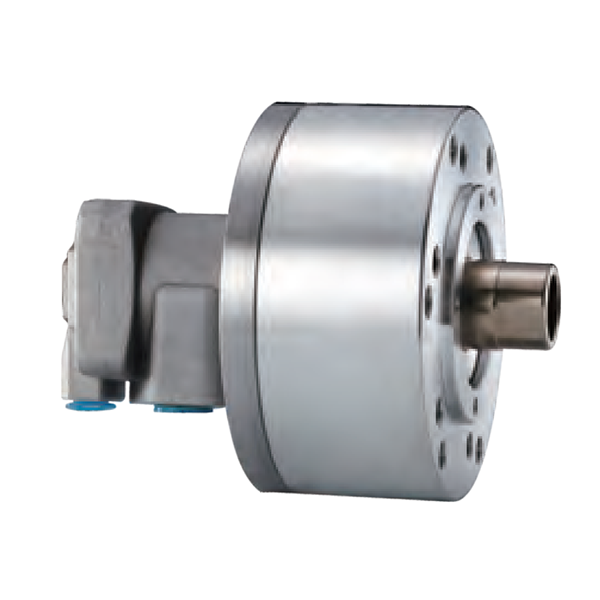
Solid rotary hydraulic cylinder for non-through-spindle clamping systems.
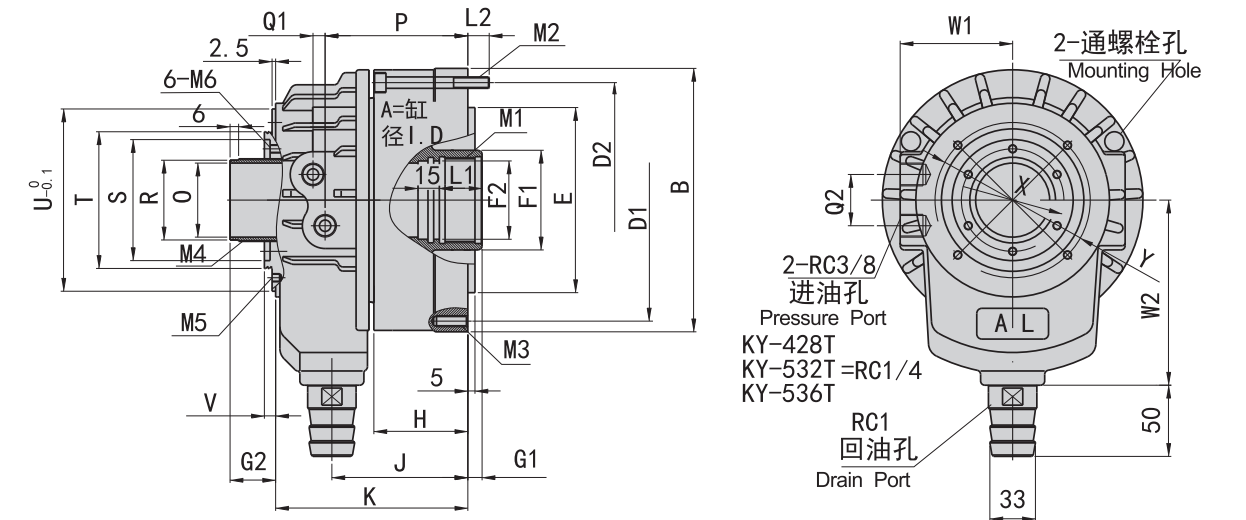
Use this drawing to confirm the solid cylinder dimensions and mounting details.
| Model | A | B | D1 | D2 | E(H7) | F1 | F2(H8) | G max | G min | H | M1 | M2 | M3 |
|---|---|---|---|---|---|---|---|---|---|---|---|---|---|
| SY-75H | 75 | 107 | 90 | 90 | 65 | 28 | 21 | 45 | 30 | 60 | M20*35 | M8*60 | 6-M8*16 |
| SY-100H | 100 | 135 | 115 | 100 | 80 | 28 | 21 | 45 | 25 | 77 | M20*35 | M8*75 | 6-M10*20 |
| SY-125H | 125 | 160 | 140 | 130 | 110 | 35 | 25 | 50 | 25 | 85 | M24*40 | M8*85 | 6-M12*20 |
| SY-150H | 150 | 190 | 170 | 130 | 110 | 45 | 31 | 55 | 25 | 98 | M30*45 | M10*100 | 12-M12*24 |
| SY-200H | 200 | 245 | 220 | 145 | 120 | 55 | 37 | 70 | 35 | 118 | M36*60 | M10*125 | 12-M16*30 |
| SY-250H | 250 | 296 | 275 | 200 | 160 | 60 | 37 | 100 | 40 | 156 | M36*60 | M12*160 | 12-M20*30 |
| Model | Push-Side Piston Area (cm²) | Pull-Side Piston Area (cm²) | Piston Stroke (mm) | Max. Speed (r/min) | Max. Pressure kgf/cm² (MPa) | Push-Side Force kgf (kN) | Pull-Side Force kgf (kN) | Moment of Inertia (kg·m²) | Weight (kg) |
|---|---|---|---|---|---|---|---|---|---|
| SY-75H | 41.7 | 37 | 15 | 6000 | 40(4.0) | 1500(14.7) | 1330(13) | 0.02 | 3.2 |
| SY-100H | 75.4 | 70.8 | 20 | 5000 | 40(4.0) | 2710(26.6) | 2550(25) | 0.04 | 4.8 |
| SY-125H | 119.6 | 111.5 | 25 | 5000 | 40(4.0) | 4300(42.1) | 4010(39.3) | 0.06 | 7.2 |
| SY-150H | 173.6 | 159.2 | 30 | 5000 | 40(4.0) | 6250(61.2) | 5730(56.2) | 0.1 | 9.8 |
| SY-200H | 314.1 | 290.4 | 35 | 4000 | 40(4.0) | 11300(110.8) | 10454(102.4) | 0.25 | 15.7 |
| SY-250H | 485.7 | 462.3 | 60 | 2000 | 40(4.0) | 17500(171.5) | 16640(163.0) | 0.52 | 45.5 |
Rotary Hydraulic Cylinder Selection Notes
- Choose hollow type when through-spindle passage is required.
- Choose solid type when the workpiece is short and through-spindle feeding is not needed.
- Match cylinder thrust and stroke with the chuck.
- Confirm drawbar thread, drawbar length and mounting dimensions.
- Check maximum speed, pressure range and hydraulic system compatibility.
- Review safety interlock and pressure stability for automated clamping.
Related Power Chuck Pages
What to Provide Before Quotation
Chuck input requirements
Provide the chuck model, permissible input force, input stroke and required push or pull direction. For replacement, include the original cylinder nameplate.
Mounting and passage
Send the available mounting space, connection dimensions and drawbar or drawtube thread. Specify the required bore when through-spindle feeding is needed.
Hydraulic and operating conditions
State the hydraulic working pressure, intended speed and existing supply and return connections so the operating requirements can be checked against the selected model.
FAQ
What is a rotary hydraulic cylinder used for?
It is used to provide the push force, pull force and stroke needed to clamp and release a hydraulic chuck through the drawbar while the spindle rotates.
Is it a chuck or a chuck actuator?
It is a hydraulic chuck actuator, not the chuck body itself. The rotary hydraulic cylinder works together with the chuck, drawbar and spindle system.
How should a rotary hydraulic cylinder be matched with a hydraulic chuck?
The cylinder should be matched to the chuck by checking stroke, thrust, drawbar connection, mounting dimensions, speed and hydraulic pressure.
What is the difference between hollow and solid rotary hydraulic cylinders?
A hollow cylinder has a through-hole for bar or tube passage. A solid cylinder is used when through-spindle feeding is not required.
What pressure, stroke and pull / push force should be checked?
Check the hydraulic pressure range, piston stroke, push-side force and pull-side force together with the chuck clamping requirement and drawbar movement.
What spindle or drawbar information is needed?
Provide the spindle nose, spindle through-hole, drawbar thread, drawbar length and the connection details between the cylinder and the chuck.
What should be checked before installation?
Check mounting dimensions, hydraulic pressure, target speed, drawbar travel, through-hole requirements and the overall compatibility of the chuck system before installation.
What information is needed for quotation?
Provide the chuck model, machine model, spindle nose, spindle through-hole, drawbar thread, required stroke, target thrust, pressure range and whether a hollow or solid cylinder is required.
What should be checked if the drawbar connection between the cylinder and chuck is loose or damaged?
Stop using the machine and isolate electrical and hydraulic energy according to its manual before a qualified technician inspects the connection. Drawbar or drawtube failure can cause sudden loss of gripping force; increasing hydraulic pressure is not a remedy.
Check matching thread specifications, adequate engagement, secure fastening and thread damage. Replace damaged components as specified for the equipment and verify the connection and clamping function before returning to service. Supply the cylinder and chuck models, connection drawing and damage photographs.