2-Jaw vs 3-Jaw vs 4-Jaw Power Chucks: How to Choose by Workpiece Shape
Power chuck jaw count should be selected from the workpiece shape, clamping surface, locating datum and cutting force direction. A 3-jaw power chuck is commonly selected for round, cylindrical and shaft-type parts. A 4-jaw power chuck is commonly reviewed for square, rectangular or four-sided workpieces. A 2-jaw power chuck is commonly reviewed for opposing-side clamping, shaped parts and custom jaw applications.
Jaw count is only one selection factor. It does not replace the need to check spindle nose, through-hole or solid structure, drawbar or draw tube, jaw stroke, cylinder matching, soft or hard jaws, clamping force, speed limit and workpiece support.
For the broader category overview, see what is a power chuck. For through-hole and solid structure selection, see through-hole vs solid power chuck.
Direct answer
Choose a 3-jaw power chuck when the workpiece is mainly round, cylindrical, shaft-type or tube-type and can be supported by three synchronized contact points. Choose a 4-jaw power chuck when the workpiece is square, rectangular, four-sided or needs four-point support. Choose a 2-jaw power chuck when the part has two opposing clamping surfaces, a shaped profile or requires custom jaws.
The practical question is not simply “how many jaws are stronger?” The question is:
- where can the part be clamped?
- what surface can be used as the locating datum?
- is the workpiece round, square, rectangular or irregular?
- will the jaws contact raw stock or a machined surface?
- does the part need soft jaws, hard jaws or custom jaws?
- does the loading method require enough jaw opening?
- does the chuck still match the machine, cylinder and spindle interface?
A jaw count that looks correct by shape may still fail if the jaw stroke, contact area or cylinder matching is not correct.
What is a 2-jaw power chuck?
A 2-jaw power chuck uses two opposing jaws. It is commonly reviewed for workpieces that can be clamped from two opposite sides, or for shaped parts where a normal 3-jaw contact pattern is not suitable.
Typical review cases include:
- irregular workpieces with two usable clamping sides;
- parts that need custom jaws;
- workpieces where three-jaw contact would interfere with the machining area;
- parts that need open access on one or more sides;
- shapes that require a dedicated jaw profile.
A 2-jaw chuck is not a low-grade or low-accuracy choice by default. It is a workholding layout for a different contact pattern. The final result depends on the jaw design, contact area, locating datum, clamping force, workpiece rigidity and machining load.
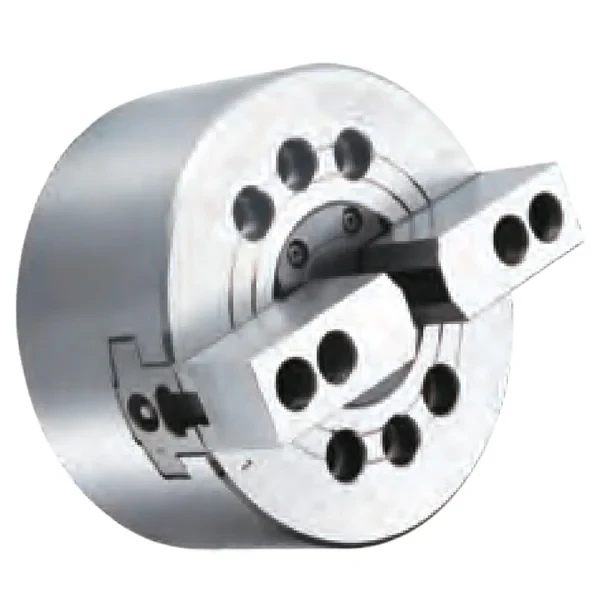
For KORRETTO products, see the 2-jaw hydraulic power chuck.
What is a 3-jaw power chuck?
A 3-jaw power chuck uses three synchronized jaws. It is one of the most common layouts for CNC lathe workholding because many turned parts are round, cylindrical, shaft-type, sleeve-type or tube-type.
Typical review cases include:
- round shafts;
- cylindrical parts;
- tubes;
- sleeves;
- bar stock;
- general CNC lathe turning;
- repeated clamping of similar round parts.
A 3-jaw power chuck can be selected as a through-hole chuck or a solid chuck, depending on the workpiece length and loading method. The jaw count and the hollow / solid structure should be treated as separate decisions.
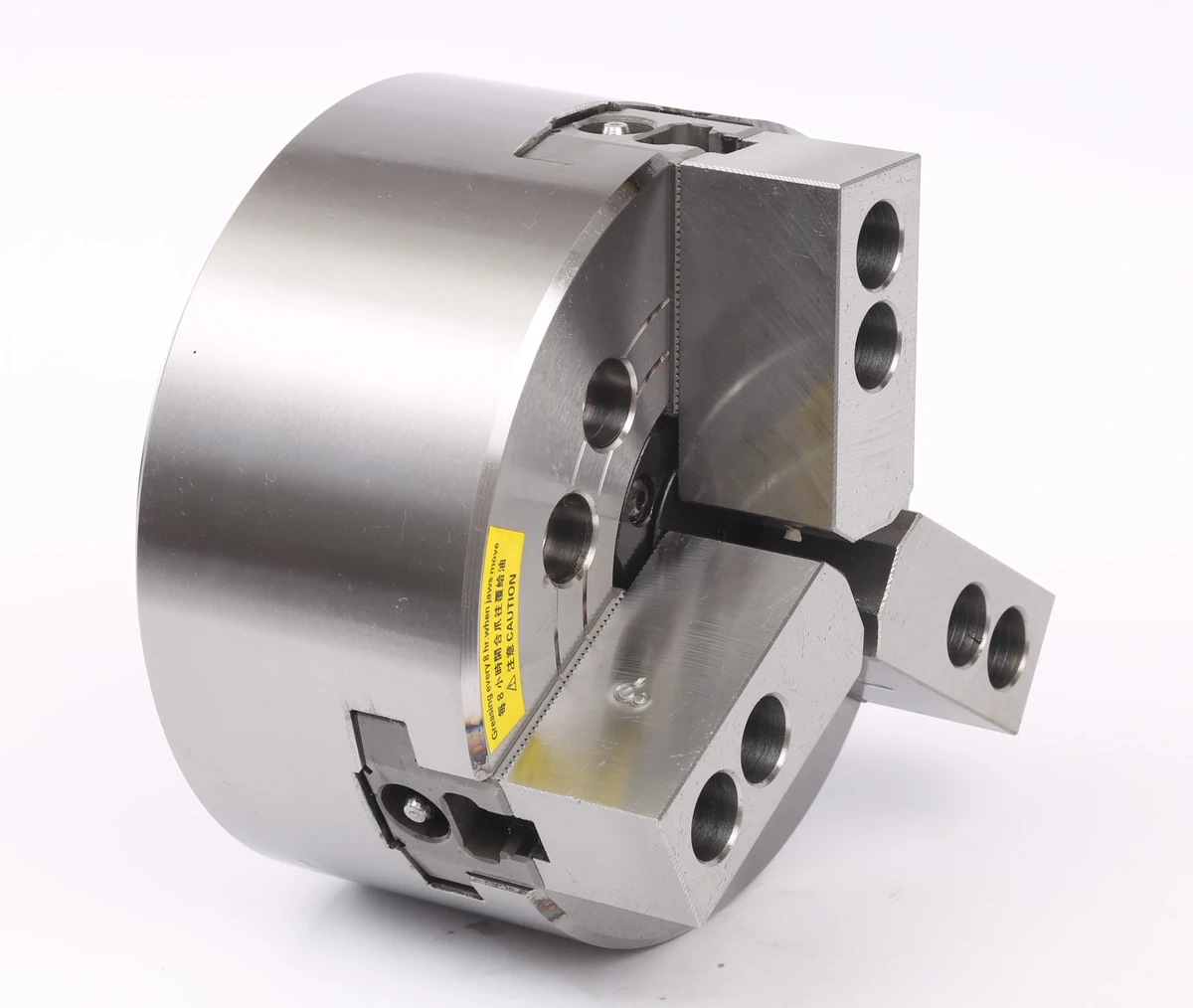
For KORRETTO products, see the 3-jaw hydraulic power chuck.
What is a 4-jaw power chuck?
A 4-jaw power chuck uses four jaws. It is commonly reviewed for square, rectangular, four-sided or workpieces that need four-point support. It can also help when the part shape does not suit a normal three-point contact layout.
Typical review cases include:
- square parts;
- rectangular parts;
- four-sided blanks;
- workpieces that need support on four contact areas;
- shaped parts where four jaws can distribute support more effectively;
- workpieces that need more stable support against a specific cutting direction.
A 4-jaw power chuck should not be treated as automatically more accurate. Accuracy depends on the chuck structure, jaw design, mounting, workpiece datum, machine condition and setup. Four jaws provide a different support pattern, not a universal accuracy guarantee.
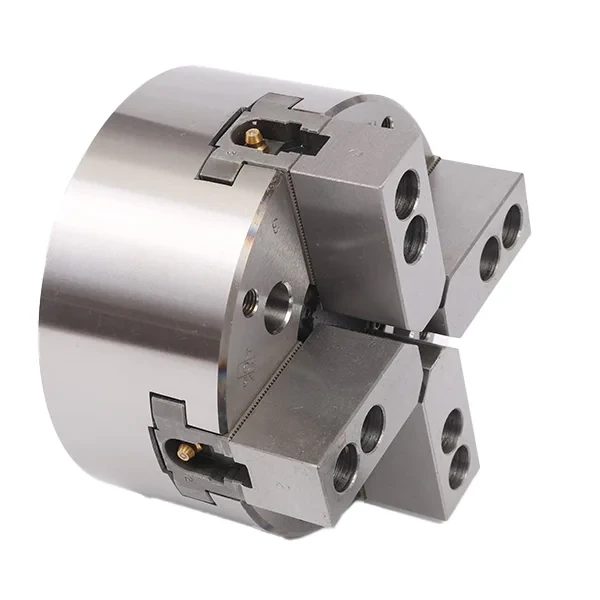
For KORRETTO products, see the 4-jaw hydraulic power chuck.
2-jaw vs 3-jaw vs 4-jaw comparison
The table below gives a starting point for jaw count selection. Final selection should still be based on the drawing, clamping surface, machine interface and process.
| Selection point | 2-jaw power chuck | 3-jaw power chuck | 4-jaw power chuck |
|---|---|---|---|
| Main contact pattern | Two opposing sides | Three synchronized contact points | Four contact points or four-sided support |
| Common workpiece shape | Shaped parts, opposing-side parts, custom jaw workpieces | Round, cylindrical, shaft, tube and sleeve-type parts | Square, rectangular, four-sided and certain shaped parts |
| Jaw design | Often needs custom jaws | Standard, soft or custom jaws depending on the part | Often reviewed with dedicated jaws for the part shape |
| Typical review reason | The part has two usable clamping sides or needs open access | The workpiece is round and suitable for three-point support | The part needs four-sided support or a four-point contact layout |
| Important checks | Opposing surfaces, jaw profile, access clearance and support length | Roundness, contact surface, jaw stroke and clamping range | Part geometry, support balance, jaw contact and datum control |
| Risk if selected incorrectly | Poor support, part rotation or insufficient contact | Unstable contact on non-round or shaped parts | Unnecessary complexity or wrong contact pattern for the part |
Jaw count is a workpiece support decision. It should be made together with jaw material, jaw shape, workpiece datum and cutting direction.
How workpiece shape affects jaw count selection
The workpiece drawing usually gives the first answer. Look for the actual clamping surfaces, not only the outside shape.
For round workpieces, a 3-jaw chuck is often reviewed first because three synchronized jaws can support round or cylindrical surfaces efficiently. For square and rectangular workpieces, a 4-jaw layout may be reviewed because four contact areas can support the sides more naturally. For irregular or opposing-side parts, a 2-jaw layout with custom jaws may be more suitable.
Important questions include:
- Is the clamping surface round, flat, square, rectangular or irregular?
- How many usable contact areas are available?
- Is the workpiece raw stock or already machined?
- Does the part need to be located from an outside diameter, inside diameter, face or special datum?
- Will the jaw contact area deform the workpiece?
- Is there enough opening for loading and unloading?
- Will the tool path interfere with the jaws?
- Does the part need custom jaws or special supports?
The correct jaw count is the one that gives stable support without blocking machining access or damaging the part.
When to choose a 2-jaw power chuck
Choose a 2-jaw power chuck when the workpiece has two main clamping sides or when a custom jaw layout is needed.
It is commonly reviewed for:
- parts with two opposing flat surfaces;
- irregular blanks that cannot be supported well by three jaws;
- shaped workpieces that need dedicated jaw profiles;
- parts requiring access on other sides for machining;
- workpieces where a three-jaw or four-jaw layout would interfere with the cutting path.
A 2-jaw layout often depends on the jaw design. The jaws may need to match the part profile, increase contact area or avoid sensitive surfaces. For this reason, drawings and workpiece samples are important for review.
When to choose a 3-jaw power chuck
Choose a 3-jaw power chuck when the workpiece is mainly round or cylindrical and the clamping surface can be supported by three synchronized jaws.
It is commonly reviewed for:
- shafts;
- tubes;
- sleeves;
- round blanks;
- bar-fed parts;
- general CNC turning work;
- repeated production of round parts.
A 3-jaw chuck is common, but it is not automatically the right choice for every round part. Thin-wall parts, deformation-sensitive parts, rough cast surfaces, pre-machined surfaces and strict datum requirements may need soft jaws, custom jaws, collets, diaphragm chucks or other workholding methods.
When to choose a 4-jaw power chuck
Choose a 4-jaw power chuck when the part shape benefits from four contact points or four-sided support.
It is commonly reviewed for:
- square parts;
- rectangular parts;
- four-sided blanks;
- workpieces that need support in two directions;
- shaped parts where four jaws can distribute support better than three jaws.
A 4-jaw power chuck is not selected only because it has more jaws. More jaws can help when the contact pattern matches the workpiece, but they can also add complexity if the part does not need four-point support.
For square or rectangular parts, the decision should consider the locating datum, cutting force direction, required jaw opening and whether the jaws can support the part without distortion.
Jaw count vs through-hole / solid chuck structure
Jaw count and chuck structure are different decisions.
A power chuck can be:
- 2-jaw through-hole;
- 3-jaw through-hole;
- 4-jaw through-hole;
- 3-jaw solid;
- or another application-specific structure.
Jaw count answers this question:
How should the jaws contact and support the workpiece?
Through-hole or solid structure answers this question:
Does the workpiece or raw material need to pass through the spindle?
For example, a 3-jaw through-hole chuck may be reviewed for long round bar stock, while a 3-jaw solid chuck may be reviewed for short disc-type parts. The jaw count is the same, but the chuck structure and cylinder matching are different.
For more detail, see through-hole vs solid power chuck.
Soft jaws, hard jaws and custom jaws
Jaw count alone does not decide the final clamping result. The jaw material and jaw profile are also important.
Hard jaws are commonly reviewed for rough stock, rough machining and situations where grip durability is important. They may be less suitable for finished surfaces or workpieces where jaw marks are a concern.
Soft jaws are commonly machined to match the workpiece. They can improve contact area and support when the part surface, datum or repeat location requires closer matching.
Custom jaws are often needed for 2-jaw and special-shaped workpieces. They may also be used with 3-jaw or 4-jaw chucks when the part needs a specific contact profile, support length or clearance.
Important checks include:
- workpiece surface condition;
- jaw contact area;
- jaw height and support length;
- clamping direction;
- risk of deformation;
- tool clearance;
- repeat location requirement;
- roughing or finishing operation.
For related KORRETTO products, see soft jaws and hard jaws.
Selection checklist
Before choosing a 2-jaw, 3-jaw or 4-jaw power chuck, prepare the following information:
- workpiece drawing;
- workpiece material and hardness;
- outside diameter and inside diameter;
- workpiece length and weight;
- workpiece shape: round, square, rectangular, irregular or shaped;
- clamping surface;
- locating datum;
- roughing or finishing operation;
- jaw type: hard jaw, soft jaw or custom jaw;
- required jaw opening;
- required support length;
- cutting force direction;
- tool clearance near the jaws;
- machine model;
- spindle nose;
- spindle bore;
- drawbar or draw tube data;
- rotary cylinder type;
- jaw stroke;
- maximum speed requirement;
- automation or robot loading requirement.
If the workpiece is not round, do not start from a standard 3-jaw layout by habit. Start from the usable clamping surfaces and the required support pattern.
Related KORRETTO pages
Related Resources
FAQ
What is the difference between 2-jaw, 3-jaw and 4-jaw power chucks?
A 2-jaw power chuck clamps from two opposing sides, a 3-jaw power chuck supports many round and cylindrical parts, and a 4-jaw power chuck is reviewed for square, rectangular or four-sided support needs.
When should I choose a 2-jaw power chuck?
Choose a 2-jaw power chuck when the workpiece has two usable clamping sides, a shaped profile, open access requirements or a custom jaw layout that does not suit a standard 3-jaw or 4-jaw contact pattern.
Why are 3-jaw power chucks common for round parts?
Three synchronized jaws can support many round, shaft, tube and cylindrical workpieces efficiently, which is why 3-jaw power chucks are common in CNC lathe turning. The final choice still depends on the surface, datum and machining load.
When is a 4-jaw power chuck more suitable?
A 4-jaw power chuck is commonly reviewed for square, rectangular, four-sided or workpieces that need four-point support. The workpiece drawing and clamping surface should confirm whether four jaws are actually needed.
Can a 3-jaw chuck clamp square workpieces?
Some square or shaped workpieces may be clamped with special jaws or custom fixtures, but a standard 3-jaw layout is not always suitable. The contact surface, datum, tool clearance and stability should be reviewed first.
Does jaw count affect clamping accuracy?
Jaw count affects the contact pattern and support layout, but accuracy also depends on chuck condition, jaw design, soft or hard jaws, datum control, machine setup and workpiece rigidity.
How do soft jaws and custom jaws affect jaw count selection?
Soft jaws and custom jaws can change the contact area, support length and part location. They are often important for shaped workpieces, finished surfaces, deformation-sensitive parts and repeat location requirements.
What information is needed to choose the jaw count?
Provide the workpiece drawing, material, shape, clamping surface, locating datum, roughing or finishing operation, jaw opening, cutting force direction, machine model, spindle interface and cylinder data.